Your LMS Shouldn't Be an Island: Webhooks, API Keys & Real-Time Automation
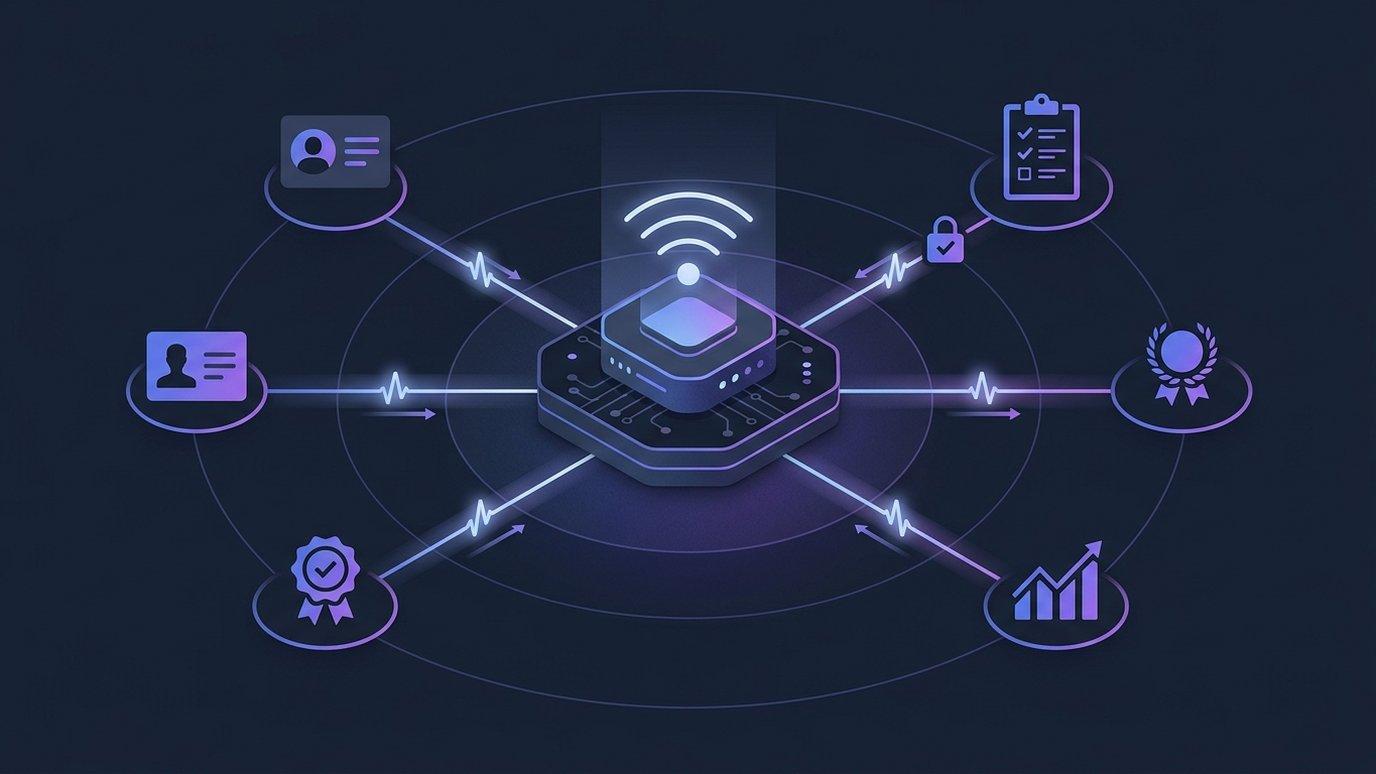
Nobody teaches inside just one system. A coaching business tracks its students in a CRM. An enterprise records mandatory training in an HR system. A school files certificates where auditors can find them. And yet in most organizations, the information that starts in the LMS gets into those other systems the slow way: someone exports a spreadsheet on Friday, someone else imports it on Monday, and everything in between is stale.
The re-typing tax
Every hour spent copying enrollment lists into a CRM, or marking completions in an HR tool, is an hour of pure overhead — and every delay between the two systems is a window where your data is wrong. The sales team follows up with someone who already enrolled. The compliance report misses yesterday's completions. The certificate a learner earned this morning isn't on file until next week.
The fix isn't more discipline about exports. It's removing the human from the loop entirely.
What a webhook actually is
A webhook inverts the usual direction of an integration. Instead of your other systems asking the LMS "anything new?" over and over, the LMS calls them — the moment something happens. You give EduGears AI a URL; when an event you care about occurs, we send an HTTPS POST to that URL with the details as JSON. Your system reacts immediately: seconds, not days.
Polling asks the same question a thousand times to catch one change. A webhook speaks exactly once — when there is actually something to say.
The events you can subscribe to
Each webhook subscription picks exactly the events it wants. EduGears AI LMS currently emits:
| Event | Fires when | A team might use it to |
|---|---|---|
| enrollment.created | A learner joins a classroom | Create or update the contact in your CRM; kick off an onboarding sequence |
| enrollment.completed | A learner finishes a course | Record the completion in HR; trigger an invoice or an upsell |
| grade.posted | A grade lands in the gradebook | Feed an analytics warehouse; alert an instructor channel |
| certificate.issued | A certificate is granted | File the credential in a compliance system; congratulate the learner |
| certificate.revoked | A certificate is withdrawn | Pull the credential back everywhere it was recorded |
| user.invited | A new user is invited to the platform | Provision the person in adjacent systems on day zero |
| tenant.domain.verified | A custom domain passes verification | Update DNS-dependent automation and internal records |
What teams build with them
- A coaching business syncs every new enrollee into its CRM the instant they join, so follow-ups and marketing segments are always current — no Friday export, no Monday import.
- An enterprise L&D team writes completions and certificates straight into its HR and compliance systems, giving auditors a trail that is complete by construction rather than by process.
- A tutoring academy triggers invoicing the moment a paid course is completed, and posts a note to the instructor's chat channel when a grade goes out.
- A certification provider mirrors issued — and revoked — credentials into an external registry, so the public record can never drift from the source of truth.
Deliveries you can trust
An integration is only as good as its worst day. Two things decide whether a webhook system is production-grade: what happens when your endpoint is down, and how your endpoint knows a call is genuine. EduGears AI answers both.
- Automatic retries: a failed delivery is retried on an exponential backoff schedule, so a brief outage on your side doesn't lose the event.
- A delivery log with replay: every attempt — status, response, timing — is recorded per webhook, and any delivery can be replayed with one click.
- Signed payloads: every delivery carries a timestamped HMAC-SHA256 signature over the exact body, computed with a secret unique to your subscription. Your endpoint verifies the signature and the timestamp — forged calls and replayed calls are both rejected.
API keys: the other half
Webhooks push events out; scoped API keys let your systems pull data and act. Each key is granted only the scopes an integration needs, is shown once at creation, and can be revoked at any time. Together they cover both directions of an integration: react to what happened, and query or update what you need. The companion post — The LMS API: Scoped Keys, Least Privilege & Integrations You Can Audit — walks the nine scopes, the endpoints each one unlocks, and the mint-rotate-revoke lifecycle in full.
Getting started
Honest expectations: wiring a webhook today is a developer task. Your team stands up an HTTPS endpoint, registers its URL under Settings → Webhooks, picks the events, and verifies the signature on each delivery — an afternoon of work for most engineering teams, and the delivery log makes debugging straightforward.
If you'd rather not write code at all: pre-built CRM and HR connectors are on our roadmap, built with early partners as they're requested. If a specific connector would unlock your rollout, tell us — real demand is exactly what sets the sequence.
Have a stack EduGears AI should fit into? Tell us what you run and we'll map the integration path together.
Talk to usFAQ
Do I need a developer to use webhooks?
Today, yes — someone needs to stand up an HTTPS endpoint that receives the events and verifies the signature. It's a small, well-documented task, and the per-webhook delivery log with replay makes testing painless. No-code connectors for common systems (CRM, HR) are on the roadmap.
What happens if my server is down when an event fires?
Nothing is lost. The delivery is retried automatically on an exponential backoff schedule, every attempt is recorded in the delivery log, and you can replay any delivery manually once you're back up.
How do I know a webhook call really came from EduGears AI?
Every delivery is signed with HMAC-SHA256 over a timestamp plus the exact request body, using a secret unique to your subscription. Verify the signature and check the timestamp is recent — that combination rejects both forgeries and replayed requests.
Can different systems subscribe to different events?
Yes. Each webhook subscription has its own URL, its own signing secret, and its own event selection — so your CRM can hear about enrollments while your compliance system hears only about certificates.
See your academy on EduGears AI LMS
Book a demo and we'll show you a live tenant branded as your academy — your name, your colors, your domain.
Book a demo →