The platform
Everything your academy needs, under your brand
A complete learning platform — white-label multi-tenancy, AI course building, delivery, analytics, standards interop, and enterprise controls.
White-label & multi-tenancy
A platform that's visibly yours
Branding isn't a settings page — it's the architecture. Your tenant resolves from your domain and dresses every surface before anyone signs in.
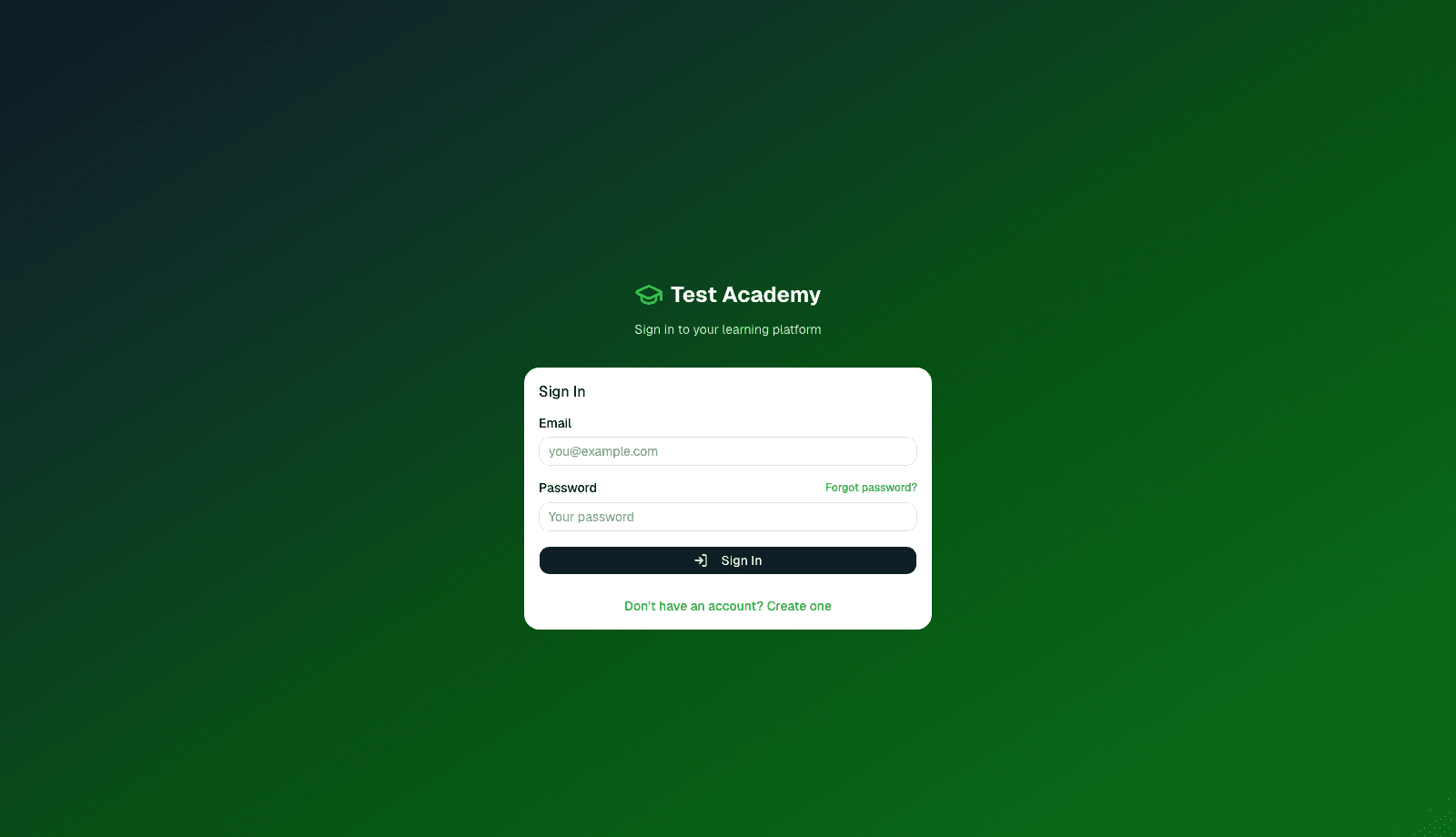
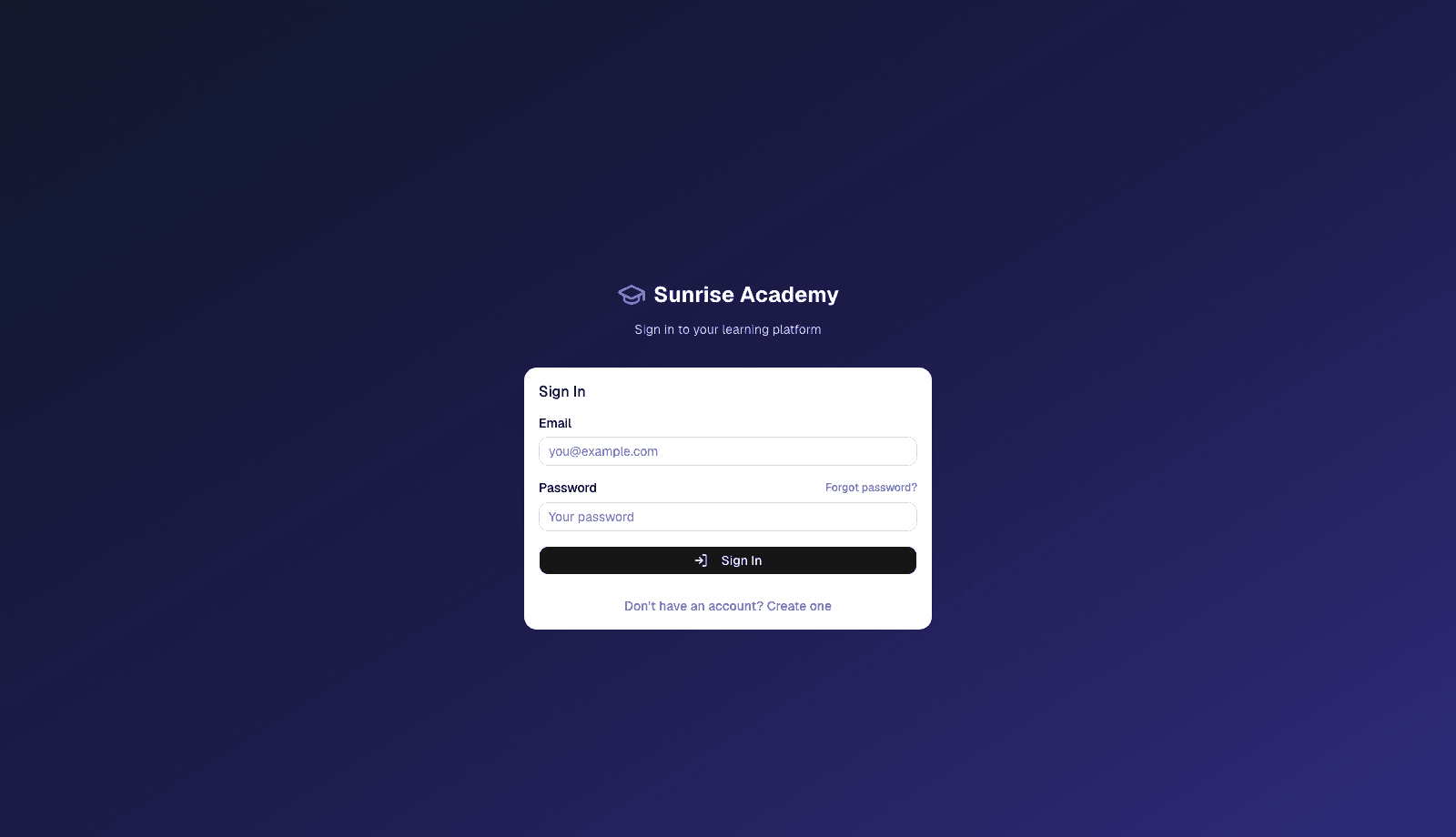
Pre-login branding
Logo, name, and colors are resolved from the host domain and rendered on the sign-in page itself.
Subdomain & custom domains
Instant subdomain at signup with live availability checking, plus self-service custom domains.
Theme presets
Palette and corner-radius characters your staff will find familiar — then override colors to match your brand book.
Branded emails & certificates
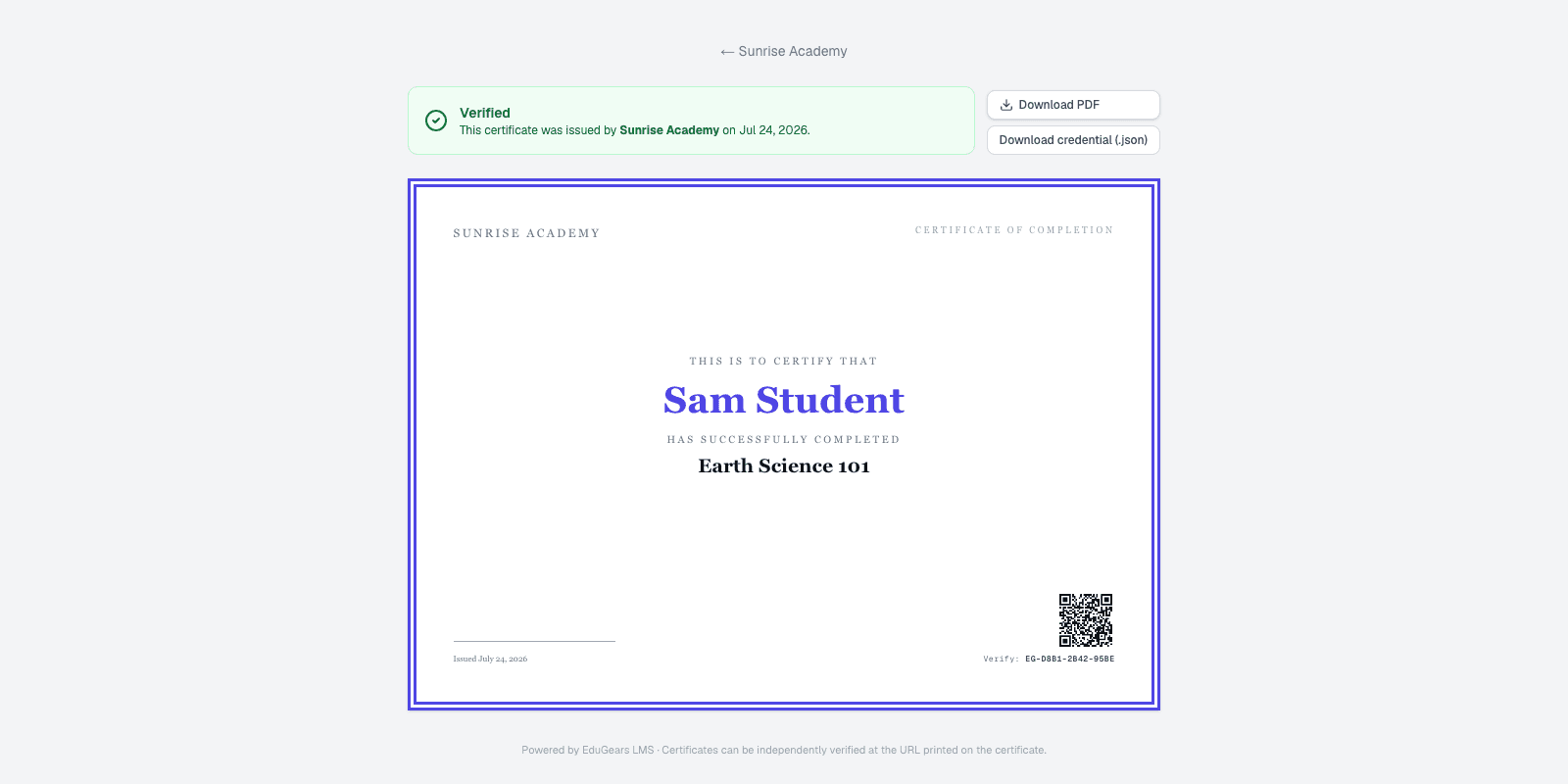
Notification emails carry your logo, accent, and footer; the public certificate-verify page shows your academy's name.
Tenant hierarchy
Run standalone, or as an organization with campuses — each with its own scope and rollup analytics.
Row-level security
Isolation enforced in the database on every tenant-scoped table — not just filtered in application code.
AI course building
From syllabus to course in one pass
Generate a whole course from a syllabus or document, ground every tool in your own materials, and keep AI spend visible.
Course from any document
PDF, DOCX, or TXT — AI decomposes it into modules and generates lesson plans, slides, quizzes, study guides, and worksheets.
Curriculum Intelligence
Per-course knowledge bases: upload materials once and generation stays grounded in them.
26 AI Tools
The complete EduGears AI suite, built in — see the full grid on the AI Tools page.
AI usage & BYOK
A live usage meter on the owner dashboard, with usage terms agreed per customer — or bring your own API key per tenant.
Teaching & delivery
Built for how academies actually run
Courses hold the content; classrooms hold the people. Programs group them, calendars schedule them, and a guided player delivers them.
Courses → sections → activities
Structured authoring with 10+ activity types across assessment, content, student work, and resources.
Classrooms & programs
Rosters, broadcast messaging, and program enrollment as a record of its own — enroll, withdraw, or re-enroll on the program itself, with its roster right there.
Sequential learner player
Lesson-by-lesson delivery with progress, resume, and Cog — the contextual AI tutor — alongside the content.
Cog, on every page
One Ask Cog bubble opens a dock that already knows the course, lesson or quiz in front of you and keeps up as you navigate. Learners get the tutor; instructors get the assistant, and can switch to the tutor to see exactly what a learner would be told.
Grading & gradebook
AI-assisted and manual grading, rubrics, grade categories per activity, and a per-course gradebook with editable cells that agrees with every report.
Availability windows & due dates
Give any activity an opens, due, and closes date. Learners are held out before it opens and warned that work counts as late after the due date, while your staff can always preview what is still closed.
Calendar & notifications
Upcoming work, calendar views, and instructor broadcasts to active learners — plus a notification when a course reaches a learner's classroom, and one daily summary email per learner, grouped by course and sent at the hour and time zone your organization chooses.
Live video sessions
Schedule a class session from a course or classroom — or an organization-wide session from the calendar — and everyone invited gets it on their calendar with an emailed invitation. Learners join in the browser: no separate account, nothing to install, and no third-party video subscription. The host holds the moderator controls, screen sharing is the host's unless you tick "Students may share their screen" for that one session, one-to-one sessions book straight from the classroom roster, and arrivals and departures are noted against the session.
Verifiable certificates
Completion certificates with QR codes and a public, tenant-branded verification page.
Program certificates
A program awards its own certificate on top of the per-course ones, and you pick the rule: every required course passed on its weighted grade, or every required course holding its own certificate. The roster separates who is ready to certify from who finished without meeting it, and a manual issue shows exactly which requirement it overrides.
Expiry & recertification
Give a course or program a validity window and its certificates expire on schedule — the record is kept, the status changes, and re-issuing recertifies the learner.
Student information system
The school office, in the same platform
EduGears AI SIS adds the records side of a school to EduGears AI LMS — admissions, student records, attendance, report cards, timetables, fees and a guardian portal — with cohorts wiring the two halves together.
Student records
Profiles, student numbers, and lifecycle status with dated history and reasons — plus guardians linked to their students and an audit log of every read and write of personal data.
Academic structure
Academic years, terms, programs and cohorts. A cohort placed on a course creates the classroom and keeps its roster enrolled — no sync job in between.
Attendance
Session registers per cohort, switched on per cohort or organization-wide, with summaries by student and session and at-risk signals drawn from them.
Report cards & transcripts
Per-term report cards with grades and comments, frozen at sign-off so a published report cannot shift, with PDF export and print templates.
Admissions, timetabling & fees
A public application form with audited pipeline stages and PDF offer letters; weekly timetables with clash detection; invoices, part-payments and balances kept as records.
Guardian portal
Guardians sign in to their own children's attendance, report cards, fees, timetable, coursework, school forms and messages — one sign-in for all their children, not one per child.
Analytics & reporting
Every role sees what it needs
Dashboards branch by role, analytics roll up across campuses, and a report registry answers the recurring questions without spreadsheets.
Role-based dashboards
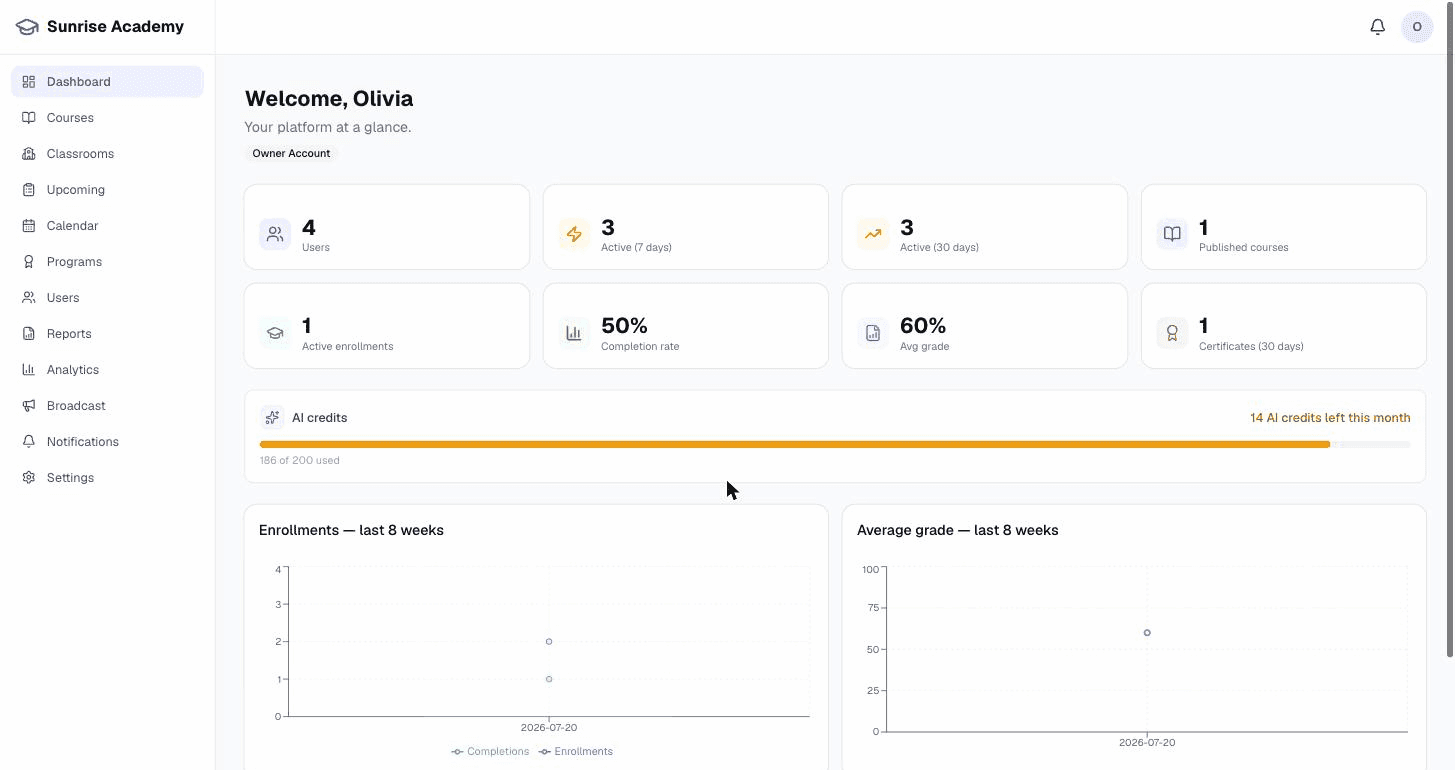
Owner KPIs with trends and AI usage; instructor class views; student progress and due-soon.
Report registry
Progress, performance, certificate, and AI-usage reports with filters, sorting, charts, and pagination.
Exports
CSV export and print-to-PDF on reports, in your brand colors.
Student 360
One learner, top to bottom on a single page: programs, courses, every graded activity, the work they submitted, and the certificates they hold — charted, read-only, and built from the same numbers as the gradebook.
Learner transcripts
A branded PDF per learner covering every enrollment, result, credit, program, and certificate — pulled by an admin or downloaded by the learner.
Org rollups
Organizations see analytics aggregated across their campuses.
Standards & interoperability
Plays well with Moodle, Canvas, and everything LTI
Content moves in and out freely, and the platform itself speaks LTI 1.3 — so nothing you build here is locked in.
LTI 1.3 platform
Host external tools with OAuth2 tokens, Assignment & Grade Services passback, and Names & Roles roster sync.
SCORM import & player
Load existing SCORM packages and play them natively inside your courses.
Common Cartridge in & out
Import Common Cartridges as editable content; export your courses as CC 1.3.
Moodle .mbz export
Hand a whole course back to Moodle as a native backup file.
QTI question export
Send quizzes and question banks out as QTI 2.1 XML that Moodle and Canvas import straight into their own question banks.
Webhooks
Push platform events into your own systems as they happen.
Public API keys
Scoped keys covering courses, enrollments, grades, certificates, users, and webhooks — each integration gets exactly the access it needs.
Organizations & campuses
One organization, many campuses
Multi-location academies, branch campuses, corporate client portals, and government training programmes run as campuses under a single organization — one catalog to maintain, one place to see everything, and rosters that never cross.
Campuses, self-service
Create a campus from the organization console and invite an admin to run it — no support ticket, no separate contract.
One shared catalog
Courses, programs, departments, and the question bank live at the organization level, so every campus teaches from the same maintained material.
Rosters stay local
Students, classes, grades, and certificates belong to one campus alone — a campus's staff never sees another campus's learners.
Isolation in the database
Campus separation is enforced by row-level security on every scoped table, not by a filter someone can forget to apply.
Org-wide rollups
Organization dashboards and reports aggregate across every campus, while each campus keeps its own view of its own learners.
Delegated administration
Campus admins run their own people and classes; the organization keeps the catalog, the branding, and the overall picture.
Enterprise
Ready for IT review
Single sign-on, federation, custom domains, and localization — the checklist items that turn a pilot into a rollout.
SSO via SAML & OIDC
Self-service single sign-on backed by enterprise-grade identity infrastructure, with IdP federation.
Role-based access
Owner, admin, instructor, and student roles with scoped permissions throughout.
Your language, RTL included
Fully localized UI including right-to-left scripts, a per-tenant default locale — and new languages added continually.
Records that survive
Dropping a student or archiving a classroom preserves grades and certificates — transcripts are never silently destroyed.